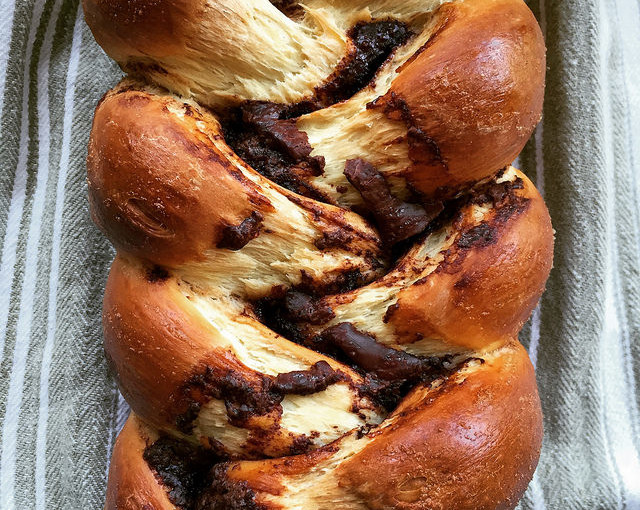

After many requests, this post was updated on 4/21/2015 to include the Nutella challah version. Enjoy!
I was initially planning to do a pure chocolate stripe through the braid of this delectable loaf of challah, but the texture of Nutella lends itself well to spreading, and who doesn’t love Nutella?
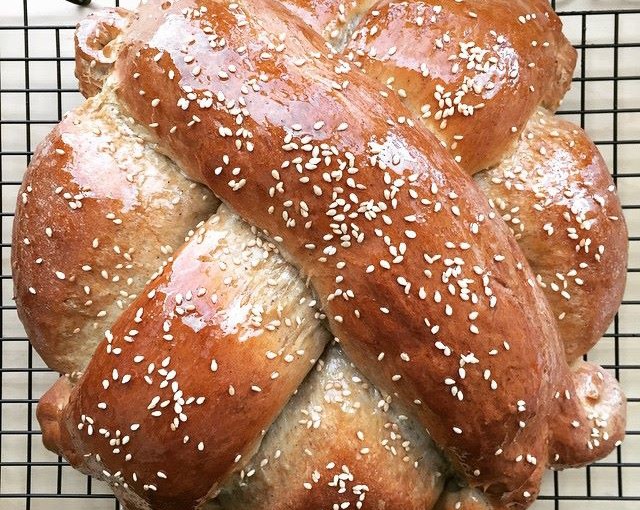
Instead of doing one giant loaf this week, I broke the recipe into two smaller loaves of challah– one with a more traditional topping of sesame seeds (and sea salt!), and the other with a fat stripe of chocolatey-hazelnut goodness running through the braid. I’ve made a few variations of challah before, but this was by far the most beautiful batch I’ve ever made. The bread itself is simply lovely; it’s got a flaky crust and a light, chewy crumb. The one downside is that it dries out a little quickly, so it’s best eaten within a day or two of baking (all the more reason to do it yourself).

Braiding the Loaves
I’m getting pretty good at the basic mechanics of working with bread dough– I’m a lot more patient about kneading it, and I think that shows in the texture of these loaves in particular. The tricky part this week was getting stable, even braids. Speaking from personal experience, if the dough isn’t firm enough, the strands will just melt together into a lumpy blob. If it’s too dry they won’t hold together. I used a spatula to sweep a healthy glob of Nutella along the inner side of each strand I set it in place. In retrospect I could have been a little more generous, as a good amount of it seems to bake away in the oven.

Baking Up and Chowing Down
I know you’re supposed to wait for at least an hour before digging into a fresh loaf, but I couldn’t help but tear off a hunk of bread pretty soon after they came out of the oven. This recipe reminded me of a toned-down version of the Greek Celebration Bread that I baked a while ago. It doesn’t have quite the same flavor-punch of spices and orange peel, and the crumb is a bit drier. However of its simplicity make it an amazing complement to a bowl of soup or a slathering of jam. I buttered mine up and drizzled some honey on top.

Pump Up the Flavor
I just discovered an alternative recipe in the New York Times that I’d love to try — it’s flavored with orange, fennel and sesame seeds and seems like it would bridge the gap between challah and tsoureki, not that anyone was asking for that. But Reinhart’s recipe is going to remain my go-to for challah; it’s pretty fast, simple and clean, and can be reinvented every time you make it.

Nutella Challah Recipe
Adapted from Peter Reinhart’s The Bread Baker’s Apprentice
Ingredients
- 4 cups unbleached bread flour
- 2 tbsp sugar
- 1 tsp salt
- 1 1/2 tsp instant yeast
- 2 tbsp vegetable oil
- 2 large eggs, slightly beaten
- 2 large egg yolks, slightly beaten
- 3/4 – 1 cup water, room temperature
- 1/2 cup Nutella or other chocolate hazelnut spread (optional if making plain challah)
- 2 egg whites, whisked until frothy, for egg wash
- Spray oil like Pam for prep
Procedure
- Stir together dry ingredients (flour, sugar, salt, yeast) in a bowl and set aside. In a separate bowl, whisk together oil, whole eggs and yolks, and 3/4 cup of water. Pour the egg mixture into the flour mixture and mix with a spoon until ingredients start to form a ball. If the dough is too dry, slowly add water as needed.
- Transfer the dough to a floured counter and knead for about 10 minutes, sprinkling in flour if the dough is too sticky. It should pass the windowpane test and register approximately 80F.
- Form the dough into a smooth ball and transfer to a lightly oiled bowl. Cover with plastic wrap and let rise for an hour at room temperature.
- Remove dough from bowl and knead for 2 more minutes to degas. Reform into ball and return to oiled bowl for another hour. The dough should swell to about 1.5x it’s original volume.
- Remove the dough from the bowl and divide it into 3 equal pieces (or 6 if you’d like to make two smaller loaves, like I did. Form each dough ball into a boule (smooth ball) and cover with a towel, then let rest for 10 minutes.
- Line a baking sheet with parchment paper. Roll three of the pieces of dough into long strands, and pinch gently to connect them at one end. Braiding dough is a little trickier than braiding hair and other, less delicate substances, but the general movement is the same. Every time you move one strand of dough over another, use a spatula or spoon to spread a bit of Nutella between the two strands. The Nutella tends to “bake off” a bit in the oven, so go ahead and be liberal with the good stuff. When you get to the end of the braid, pinch the ends together gently to close. Repeat with second set of dough if making 2 loaves.

- Transfer the loaves to the baking sheet. Brush the loaves with egg wash (save the rest for later). Spray one side of a piece of plastic wrap with spray oil and loosely cover each loaf (oil-side down, of course).
- Proof for 60-75 minutes, or until dough has grown 1.5x its size. Preheat the oven to 350F.
- Brush the loaves again with egg wash. Bake for 20 minutes, then rotate pan and bake for another 20-45 minutes, depending on how big your loaves are. The bread will be deep golden brown and sound hollow when tapped from the bottom.
- Transfer to a rack and cool for at least an hour before slicing and serving. Serve by itself or with a healthy dollop of MORE Nutella.


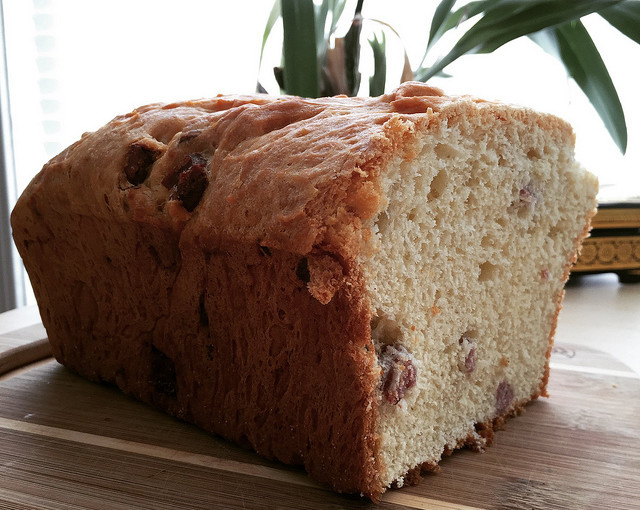



 This tsoureki is enriched with eggs, milk, oil and honey, and is generously flavored with orange rind, allspice, nutmeg, cinnamon, cloves and almond extract. It smells awesome, from the first step to the last. Other versions of this bread include more substantial additives like raisins, walnuts, dried fruit and even hard-boiled eggs, which would be interesting to try out. You can see in unbaked bread just how much spice went into this dough– it’s visibly flecked with goodness.
 After I baked the bread, I immediately gave it a wash of honey, sugar, water and orange extract (I didn’t have a bottle on-hand, so I simmered some minced orange peel with the honey mixture to give it an orangey scent and hue), as well as a sprinkling of toasted sesame seeds. The glaze does make the crust stickier than I usually like my breads to be, but the sweetness really balances out the dense, flavorful loaf well. In the future I might up the water to honey and sugar ratio to make it a little less sticky.
 This bread was really fun to make! Sometimes the ingredients in a loaf of bread can feel pretty boring, since it’s often a conduit for other foods with stronger flavors. One thing that my pictures don’t really convey is how MASSIVE this bread baked up to be– it’s impressively large and I can see how it would make a great centerpiece for a holiday meal. I’d love to try miniature versions of this style to eat as a breakfast bun or a sandwich.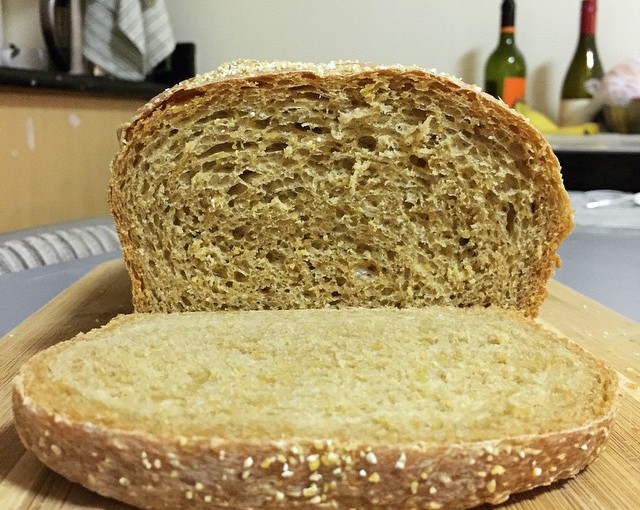

 Corn was also the bassline of my bread this week, the first alphabetically in The Bread Baker’s Apprentice. When I was a kid we used to go to the farmers’ market to buy loaves of “squaw bread,” which was dark and sweet and grainy and delicious by itself and for a sandwich. Anadama reminds me a lot of that bread — it’s lightly sweet, with a texture that just screams “please spread something on me!” …In the most PG way possible. The sweetness of the bread comes from an overnight cornmeal “soaker” and a few tablespoons of molasses, a fun ingredient that looks super cool as it rolls down the mini mountains of flour in a bowl.